Different Philosophies
What surprised me the most is the number of different beekeeping philosophies, or maybe a better word would would be strategies, that have emerged over the years. Entire books have been dedicated to the various ideas so there is no need to discuss here except for the fact I looked into various methods before I decided upon which method to use.
The discussion below focuses on two methods that are commonly used in the United States.
The Langstroth Method
In the United States, the most common is the Langstroth method. The inventor, Reverend L. L. Langstroth is an interesting man. He is considered to be the “Father of American Beekeeping.” According to Wikipedia, he was born in 1810, attended Yale University, and was an ordained Minister. He was the pastor for several Congregational churches.

Langstroth was popularly credited with discovering the “bee space,” though this discovery had already been implemented in European hives. Langstroth revolutionized the beekeeping industry by using this concept in his top-opening hive. In the summer of 1851, he found that by leaving an even, approximately bee-sized space between the top of the frames holding the honeycomb and the flat coverboard above, he was able to remove the coverboard quite easily, which was normally well-cemented to the frames with propolis, and made separation difficult. On 5 October 1852, Langstroth received a patent on the first movable frame beehive in America.
The Langstroth hive is any vertically modular beehive that has the key features: of vertically hung frames, a bottom board with entrance for the bees, boxes containing frames for brood and honey (the lowest box for the queen to lay eggs, and boxes above where honey may be stored) and an inner cover and top cap to provide weather protection. The frames are designed to prevent bees from attaching honeycombs where they would either connect adjacent frames, or connect frames to the walls of the hive. The movable frames allow the beekeeper to manage the bees in a way which was formerly impossible.

The Langstroth frame did create a lasting change in beekeeping, at least in the United States. Before removable frames were created, the beekeeper essentially had to destroy the bees’ hive whenever honey was harvested. This resulted in a loss of resources due to both the destruction of the hive but also the common practice of eradicating of the bee colony — particularly in colonies found in hollow trees
These frames can be found in at least three different sizes:
- deep — 9 1/8 inches
- medium – 6 1/4 inches
- shallow – 5 3/8 inches
Another configuration is a “double deep” which is connecting two deep frames together, or making the side bars 18 1/4 inches long.
The Langstroth method several advantages. In my mind, the most important is that it is essentially a Commercial off the Shelf (COTS) system. While this a term usually used in software development, it means that the parts are readily available, there is a support system in place, and it decreases the time needed to go into production.
There are also some disadvantages which led me to not using this system. The Langstroth method entails frequent inspection which involve lifting the various boxes and doing a frame by frame inspection. Some of these boxes can weigh when honey production is at its highest level can weigh up to 100 pounds. I have a back injury from my time in the Navy, which limits how much I can lift, particularly in the middle of a field where there may not be sound footing.
The Layens Method
Georges de Layens (January 6, 1834 – October 23, 1897) was a French botanist and apiculturalist. He was the creator of a beehive called the “Layens hive”.
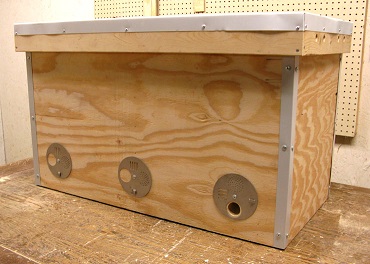
Georges de Layens emphasized that sustainable beekeeping rests on two principles: using local bees and keeping them in appropriate hives that are gentle on the bees and the keeper alike, and require minimal management. The Layens hive is a horizontal hive holding 20 large frames (13” long by 16” deep) on one level. (The number of frames can be smaller or greater depending on your local honeyflows.)

“Keeping bees requires little effort, and barely any capital to get started,” wrote Georges de Layens in Keeping Bees in Horizontal Hives: A Complete Guide to Apiculture (paid link). Personally, I am not sure of the former and the latter is still generally true, although, since the pandemic, prices of lumber and other needed supplies may be out of reach to some people.
The disadvantages of this method include the lack of available prebuilt components at a reasonable cost, lack of support, and to repeat, lack of support.
The big advantage that persuaded me was that the most weight to deal with in the field, during inspections, was about 8 pounds.
Decision made. Time to move.
Last modified
Leave a Reply