10/18/2025
Ever since we began beekeeping, we knew that at some point, there would be enough honey to warrant a honey harvest. And truthfully, we didn’t know if it would be this year or the next, but in either case, we thought it would be prudent to prepare.
Methods of harvesting honey
There are two methods to harvest honey. You can cut the cone out of the frame and crush it, or you can use a centrifugal extractor.
Crushing

Crushing the honeycomb captures all its aroma and flavor, producing the most nutritious honey with a maximum pollen count. This also separates wax with minimum honey loss. You simply cut the comb out of the frame, load the comb into the press, turn the handle, and watch honey pour out.
The advantage of this method is the cost of the equipment, which is typically less than $400.00. The disadvantage is that the bees have to replace the crushed comb every year.
Centrifugal Extractor

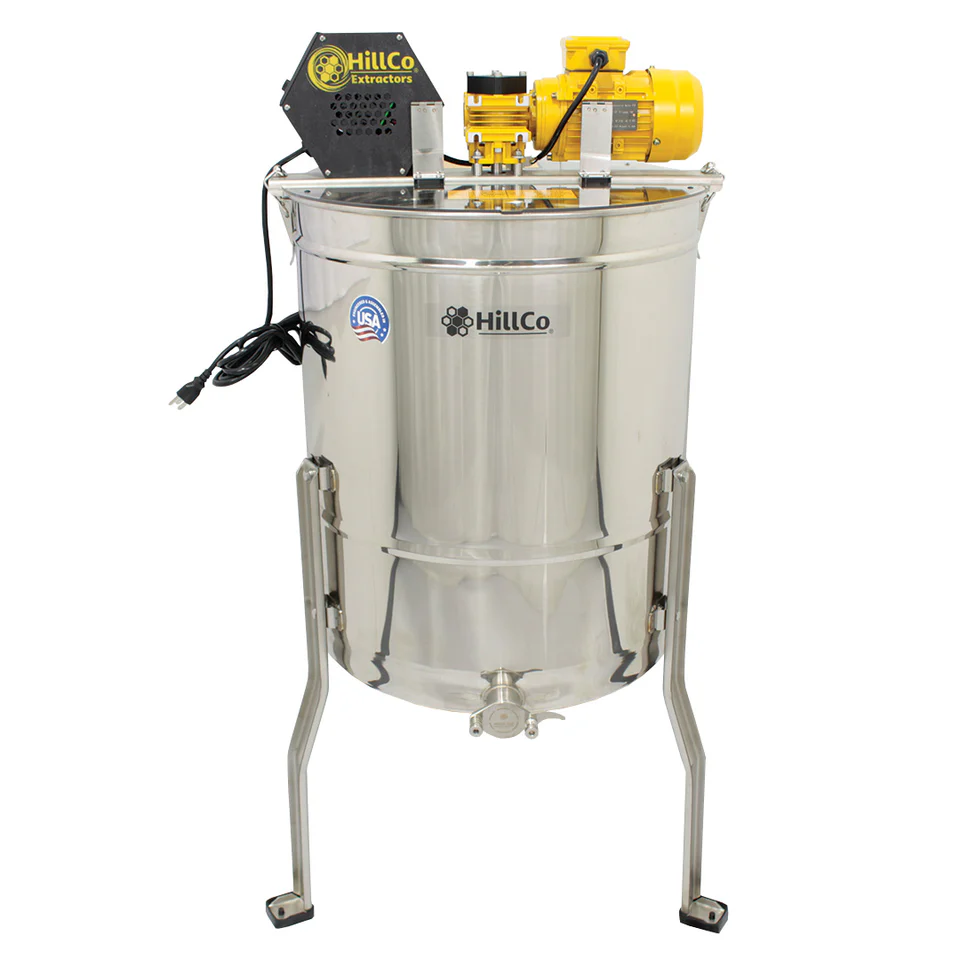
A centrifugal extractor uses the force derived from spinning the frames in a circle to hurl the honey from the frame into the bucket of the extractor, where it collects and then pours out of the spout located on the side into a bucket or holding tank.
The advantages of the type of extraction are the speed at which the frames are processed, the method is generally less messy and wasteful, and the remaining wax can be reused by the bees. The main disadvantage is the initial cost; units run from upwards of $600. Another minor disadvantage is the space required to store the extractor. Even the smallest ones are rather large.
Extraction decision
Our decision was informed by something we did in late June. We decided to do a hive inspection and pull a few honey frames. The bees were not impressed. We managed to get three before the bees chased us out of the apiary. Now granted, we didn’t use much, if any, smoke, so we probably deserved the treatment we received. Everything happened so quickly that not many pictures were taken. We do have this one after we got back to the kitchen.

A big piece of comb broke off this frame and stayed in the hive.
After cutting and crushing the best we could from three frames, it became a sticky mess that took days to clean up; we decided this method wasn’t the best option for us.
We did harvest a couple of pints of clear honey and a couple of quarts of comb mixed with honey, so it wasn’t a complete loss. That said, about the same amount was wasted.
This experience helped us decide to get a centrifugal extractor.
Looking for a vendor
With the decision more or less complete, it was time to find a vendor. In the Layens world, there aren’t many to choose from. And you can count on the product being expensive.
We looked at the offerings from HorizontalHive.com and saw more choices than before. They were not chosen due to the shipping cost of the one we were interested in, coupled with the wait time. Don’t misunderstand, all of their products are great, but in this case, it didn’t work out.
We also checked other various beekeeping supply places, and nobody had anything available. Then we found HillCo, LLC, a company with its headquarters in Illinois. On the website, they had one offering and it had all the features we needed.
The extractor
According to the website the features include:
- Proven HillCo PowerMaxx drive system: an industrial grade motor, gearbox, and controller.
- Smooth, quiet and durable, it’s a great combination of simplicity and refinement.
- This is the same design that we use all the way up to our big 32 frame extractors! 22 gauge, type 304 stainless steel tank
- Ez-Drain honey gate design: the honey drain valve is located slightly below the tank floor, giving you a complete, seamless honey drain.
- HillCo-exclusive tank bottom that slopes towards the front, ensuring that all your honey flows smoothly towards the gate. No tipping the tank, no hassle, it just works!
- Industry exclusive 4/10 warranty: motor, gearbox, controller, and wiring are guaranteed for 4 years. The rest of the machine (tank, legs, lower bearing, reel, etc), are guaranteed for 10 years.
Other features/specs:
- 1/4 horsepower PowerMaxx motor, 5:1 ratio worm-drive gearbox
- Extracts 3 Layens frames, or 3 deep Langstroth frames, or 6 medium/shallow Langstroth frames, all tangentially (meaning you extract each side of the frame separately)
- Grease-able lower bearing
- Rubber feet to protect your floor
- 5 gallon bucket and strainer fit below the honey gate
- Tank diameter – 21″
- Width (at widest point of legs) – 29″
- Overall height – 48″
It looked like a real workhorse, and we really liked the fact that it was designed and assembled in the US.
Linda called the company and purchased it over the phone. As the call was ending we found out they took 10% off for local pickup.
We checked the map app and found that they are about 4 hours from us. It was decided that we would pick it up on October 7th (one of the perks of being retired is day trips).
The Trip
We had a nice, uneventful trip to Minonk, IL – where HillCo, LLC is located. When we bought the extractor, we asked for recommendations for places to eat. They suggested Minonk Lanes & Grill, which was located across the street from them. We decided to give it a try.
We arrived at 11:30, just in time for lunch. The special that day was a grilled cheese sandwich with bacon & tomato. I am, in general, not a fan of grilled cheese, but I had never had it with bacon & tomato. It sounded crazy enough to be good, and it was.
The Shop and Factory

The shop and factory are located in a renovated bakery, which gives it some interesting interior features. Inside the shop, we met Mason, who proceeded to give a tour of the shop and an explanation of the items we had a question about. They carry all things beekeeping. Many of which I had never heard of – very engaging.


He powered up an extractor with the same controller as ours and gave a detailed explanation of how it works. He also explained the importance of load balancing the extractor to reduce the wobble during operation.
After the extractor was loaded in the car, Mason gave us a tour of the rest of the facility. We didn’t know what to expect, but it was bigger than I imagined. Open and airy layout with work areas and work centers laid out in a logical manner.


Just a few pictures of the factory side of the facility.
This is where most of the social media posts are created.

One of the things that most interested me was the 3D print farm. It is where most of the controller covers are made, plus a lot stand alone products. I was very envious.


That’s a lot of printers. And they were all printing something.
Conclusion
After the tour, we headed home. And, once again, the trip was uneventful.
If you need beekeeping supplies, I would recommend HillCo, LLC.
Last modified:
Leave a Reply