3/19/2024
Happy first day of Spring! And it’s been a pretty good day all the way around.

I know it might seam strange to talk about soap, especially on the first day of Spring, but that is what happened and that’s what we’ll do.
The beginning
We started making soap sometime in the early 90’s when our daughter was in scouting. The troupe was planing a day themed “Little Scouts on the Prairie”, and Linda said she would demonstrate soap making.
She had seen her Granny make soap and from what she remembered, it looked pretty easy – it never is. Anyway, she borrowed a book from her and began to studying it. After a week or so, she threw the book across the room and said something to the effect of “I don’t understand!”
I picked the book up, read through it, and said “It’s just chemistry.” That didn’t go over very well. Anyway, I got some lard and lye, mixed up the lye to the correct proportions, melted down the lard, mixed it up and soap was created. As you can guess, I had to do the demo for the scouting event. Since then, we quit buying bar soap and use what we make
T.O.C
What is soap making?
That is a question with many answers. For some artists it means buying glycerin soap, melting it down, adding colors and/or pieces of herbs, and then pouring the mixture into a mold and calling it good. There is nothing wrong about calling it soap making, because they are creating a new product out of an existing one. It’s sort of like going to the lumber yard, buying wood, and then making a table. You didn’t create the wood, but you call it wood working.
Our definition and process is somewhat different. I create a soap recipe using several different oils and fats, playing off up the strengths of the individual substance, which when a lye solution is added to it, will create a soap with the characteristics that I want.
For example, using just olive oil and lye as ingredients will make a very white, very hard bar of soap with very little, if any, lather. If I take the same recipe and add coconut oil to it and adjust the amount of lye it will create a hard bar of soap that will produce a good amount of lather.
The chemical process of making soap is saponification. I looked for a better explanation of the process, but all of them keep real deep in the weeds. In simple terms, saponification describes the process when an alkali substance – typically sodium hydroxide, commonly called lye – interacts with fat to form soap.
This process also produces glycerin. I – like most soap makers – leave it in the soap. It’s actually the properties of glycerin that is the basis of the many “old wives tales” about lye soap. Most of these tales involve some sort of trauma to the skin: poison ivy, sunburn, tick bites, and on and on. The soap will help clean the trauma, the left behind glycerin makes the area feel better.
Last month, Linda let me know that we were running out of soap. This prompted me into looking at the recipe we had used for the last few years. The basic ingredients were palm kernel oil, coconut oil, olive oil, soybean oil – both solid and liquid, and castor oil.
I knew that we had used all the castor oil and Linda had made it clear that future batches would not have as much, if any, castor oil. Castor oil – which is really a wax – makes soap feel silky, but it leads to rings around the bath tub. A good substitute is grape seed oil.
I remembered that we needed a new scale. We had always used an old spring scale shown below, but when we cleaned up the last time we made soap we wiped most of the numbers off. So it wasn’t really useful for making soap anymore.

In it’s place, I ordered this scale from Amazon.

One of the better features of this scale is the Tare function which is telling the scale to start a new measurement from whatever the current weigh point is. It’s what I used to call in the Navy, zeroing the meter.
We were also low on palm kernel oil, so I ordered some from Soaper’s Choice. This is a great resource for soap makers.
With all of this background, let’s talk about today’s events!
What happened today?
The first thing we did was to mix up the lye solution. I used 64 ounces of water split between two glass bottles and added 30 ounces of lye crystals. To do this safely at a minimum you need gloves and at a maximum a tyvek suit, splash guard, gloves, and safety shoes. I’ve done this for awhile and I might have forgotten to wear gloves. You really should be very careful, this stuff will burn.
You always add the crystals to the water. Doing it the other way around will cause a very alkaline solution to be distributed all over the room in a violent manner. So be careful.
The reaction between the water and lye is exothermic – meaning it produces heat – a lot of it. The temperature of the water maxed out at around 275 degrees F.
Next we measured out the various oils.
Today we used:
- 3 pounds 12 ounces of palm kernel oil
- 3 pounds of coconut oil
- 3 pounds of olive oil
- 1 pound 4 ounces of soybean oil
- 1 pound 4 ounces of shortening
- 1 pound of grapeseed oil
After the oils were measured out, we began to melt them together using a low heat. After they have melted, it makes a golden solution.

The next step was to pick out the fragrance. Something we both have to agree on. We purchase our fragrance oils from the Wellington Fragrance Company. They carry an incredible selection of both fragrance and essential oils. Today we had a little bit of lavender rose, some lavender, and a bottle of rose. I added the lavender to the lavender rose and topped off with rose. It was a total of about 6 ounces by weight. Once mixed up, it was added to oil.
Once the lye solution and oil solution were about the same temperature, it was time to mix them together.


I use a wooded spoon to stir the lye into the oils.
The oil after the lye is added.

The oil solution goes from clear to cloudy indicating that soap is being produced.
After the initially adding the lye, I change over to a “stick blender.” The one we have is similar to this one.


I continue to stir the mixture together until it starts to trace.

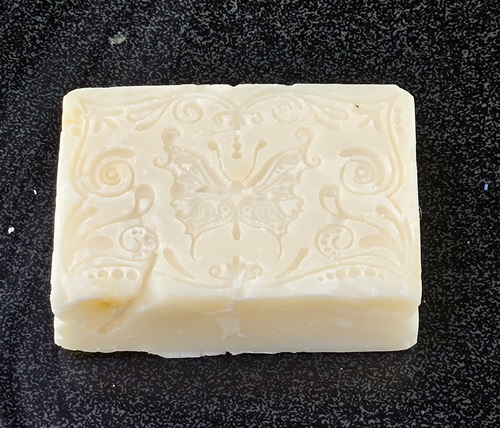
All that was left is to fill up the molds.


This is just a few of the molds we use. I’ve made a couple of wood ones, we even use a piece of 3 inch PVC pipe.
The next issue is how fast the new soap cools down. When the lye is added to the oil, it heats up again. If it cools down too quickly, the batch will separate. This we know from experience. The pipe was placed in a cooler for temperature control, and all the silicon and plastic molds were covered with old towels to do the same.
The soap will remain covered for at least a week and should be ready to use a couple of weeks after that.
Last modified:


Leave a Reply