September 1, 2023
I decided this would be a good day to work on frame tops. Of all the pieces of a frame the top takes the most amount of work.

First the frame needs to be cut to a length of 14 5/16 inches and then to a width of 1 1/2 inches. After that a 1 1/16 rabbit needs to be made on each end. Then, finally, 4 spaced out holes are drilled through the top to accommodate the wiring.
I had previously cut 70 blanks that would be turned into frames.

I expect that a few will fail on the way due to either faults in the wood or a mistake made by me. Regardless, this should be enough for next year.
The first task is to setup the table saw for the initial rabbit cut.


I used the setup guide to pick the number of blades and chipper thickness. Once those were installed I used a jig a made last year to set the height of the blade. Each side will need to be run twice at different lengths to cut out the full 1 1/16 inch.
Let the cutting begin. A few minutes later the first cut was completed. About this time, Kate decides to join the party.

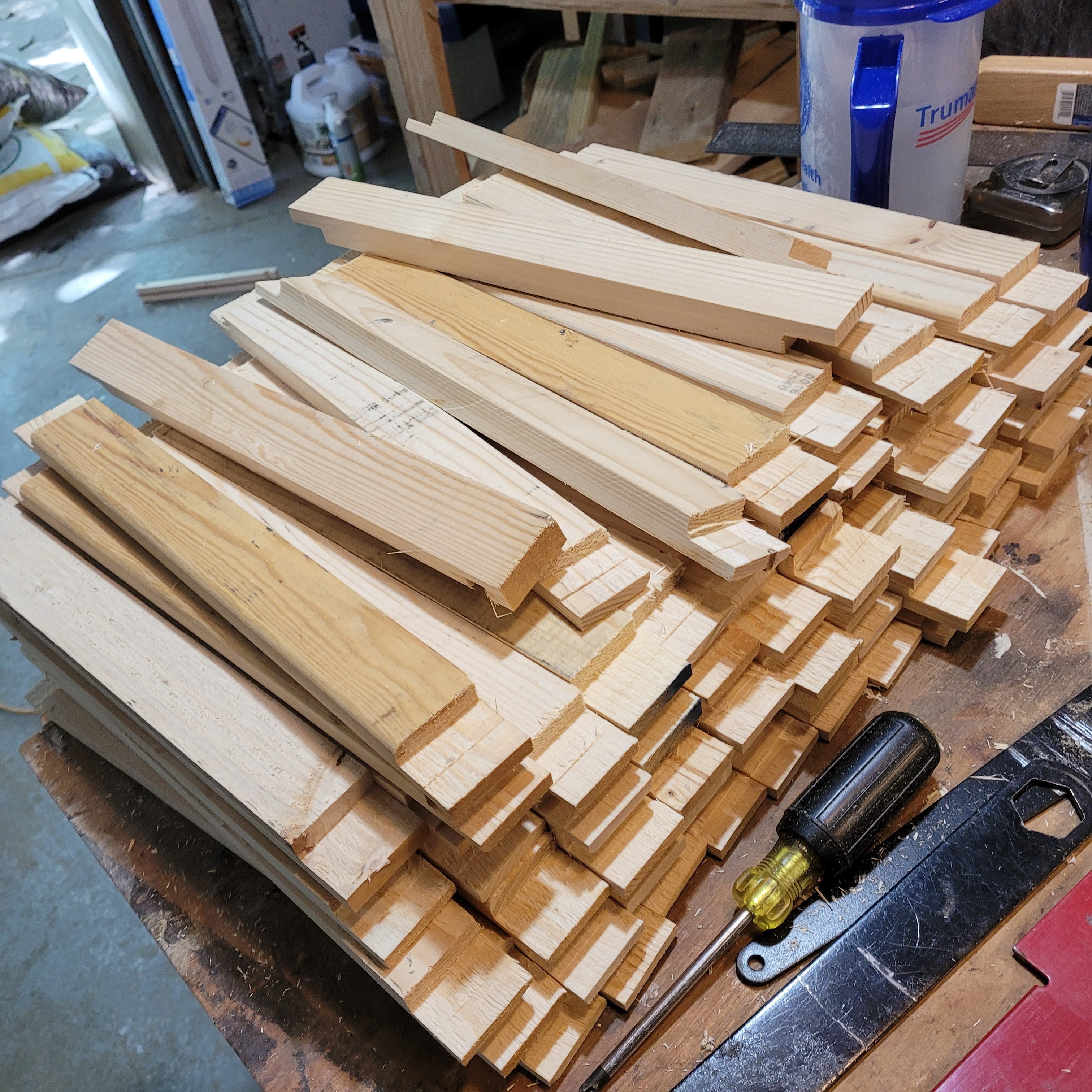
The then blanks now tops after the first cycle of cuts.

You can’t tell from the picture below, but I am totally covered in sawdust. It took several minutes to get enough off so I could continue on.

Setup for the second cut. I wanted the blades to just barely be over the end of the top. Sometimes, this helps prevent chipping.

During this setup, I saw that I made a mistake. It could be worse.

Results of the second run. For the most part, they look good.

Of course, there were a few rabbits that needed to be cleaned up with my sander.

Then I noticed something strange. About 10 or so of the tops were thicker than 3/4 inch. All of the blanks were cut from milled lumber, meaning I didn’t have to cut the boards to the correct thickness. I guess that’s why I have a jointer.

Fortunately, none of the tops splintered much while I was getting them to the correct thickness.
The next step seemingly takes forever. First you have to mark where the holes will be drilled using the jig. And then, you actually have to drill the holes. There were about 70 tops, so that means 280 holes needed to be drilled. I’m really glad I have a drill press for tasks like this.


All finished. It took about four hours to make the tops.

Last modified:
Leave a Reply