2/27/2025
I hope everyone is having a great winter season. I’m not sure we are just yet. More details later.
Lots of stuff to cover including what the bees are up to, greenhouse activity, the crazy cold temperatures, and the recovery.
The Bees
During the winter the bees mostly stay in the hive all grouped to try to keep warm, so you hope that they are doing alright. But on the more temperate days, they can often be found buzzing around.
We caught them buzzing around and had a chance to record it.
They are looking pretty good. It’s always a good day when you can visit with the bees.
To help get them ready for spring, we’ll start feeding them next week and continue until the flowers start blooming.
Finishing up the greenhouse
A lot of time was spent last year preparing the greenhouse for planting. That said, there was still much to do.
We needed to install grow lights, heat mats, and a shelf unit we call “the greenhouse in a greenhouse.”


And as you can tell from the pictures, setting up is often cluttered until you figure things out.
As you can tell from the links in the captions, I bought almost everything from Amazon. The trays were obtained from GreenHouse Megastore in what they call the “MegaGrow Propagator Triple Pack.” The trays are much heavier than I thought they would be, which is a good thing.
One thing we didn’t realize was that the plant shelf unit didn’t come with heat mats, so they had to be ordered separately. We chose the Seedling Heat Mat from Amazon in the two-pack. These are pretty good mats but they don’t have a thermostat so unless you find a way to control them, they are on all the time.
The heat mats for the big shelves did have thermostats, so there was one less thing to worry about.
Greenhouse controls
The last time the greenhouse was used was about 30+ years ago. At that time there wasn’t an easy way to remotely monitor and control it. That meant the grow lights and heat mats were on all the time unless you made multiple trips to the greenhouse to manually control it.
I use Home Assistant to control most things in the house including lighting, locking doors, thermostats, and much much more. A part of Home Assistant is Esphome which is a resource that provides a framework for users to build their own devices.
Using this framework, I built a system that monitors temperature and humidity with common off-the-shelf components.
Bed Monitors
The bed temperatures are monitored using the device below. It uses what is referred to as 1-wire technology. The system allows low-powered, low-cost devices to be utilized for various purposes.

It doesn’t look like much, but they work great. I had several on hand because I needed one for a project a while ago and they are only sold in groups of five. I used them on the first four shelves.
Other instruments
I needed a way to monitor greenhouse temperature and humidity. It would also be nice to measure the temperature and humidity of the shelf unit and the barn.
For this, I had a device called the TH11. Not to get too technical but, humidity readings have to be temperature-compensated. This little chip has that built into its firmware.

I built a Stevenson screen to keep the sun from directly hitting the instrument measuring greenhouse conditions. I found a couple of different examples and chose to use this one.

The instruments are wired to an ESP32 device that collects the data, changes the units to empirical, and then sends the data by WiFi to my Home Assistant server. I had to create the firmware for the device which amounts to calling up some predefined libraries and defining names for the devices.

When the picture was taken it looked very messy because installation never goes as planned. It still looks cluttered, but it is functional and for now I’ll take it.
How does this work?
Linda asks this question a lot. I use the greenhouse and shelf temperatures as control elements. That means when the temperature is too high or too low, I use an automation in Home Assistant to control the black device shown below. Two of them are used to turn the heaters on and off and another to control the heat mats in the shelf unit.

Two white devices like the one shown above control the grow lights according to a schedule I established.
Barn Dashboard
One last geeky thing to describe and then off to the fun stuff. In the middle of January, I thought it would be great to create a dashboard that displayed live data of the above instruments and other relevant data. I had no idea how to do this, so a little research needed to be done.
I finally chose a WaveShare 7.5-inch epaper as the display piece and used an ESP32 device made by WaveShare to act as the controller.

I think it came out all right.
The actual programming consisted of calling several libraries of preconfigured elements, importing the values to be displayed, and then using an offshoot of the C language to display the data.
The First Plants
Last fall Linda and Stephanie went to the Baker Creek Heirloom Seed Company to get most of the seeds needed for this year. As I understand it, this is a great place to visit.
After working hard in November and December, we were ready to start some seeds. On January 5th the first seeds were started. Our plan was to use the shelf unit first because of the way it was enclosed and then use the other shelves as temperatures became more temperate.
Pictures of the first plants.


We had good luck getting the seeds to sprout and begin to thrive. So we started more towards the end of January.


As you can tell from the pictures, we quickly filled up the shelf unit and moved to the rest of the greenhouse shelves.
We quickly learned that keeping track of when the seeds were planted and when they should sprout is going to be a problem, so we bought a whiteboard for Linda to maintain. A little old-school, but effective.

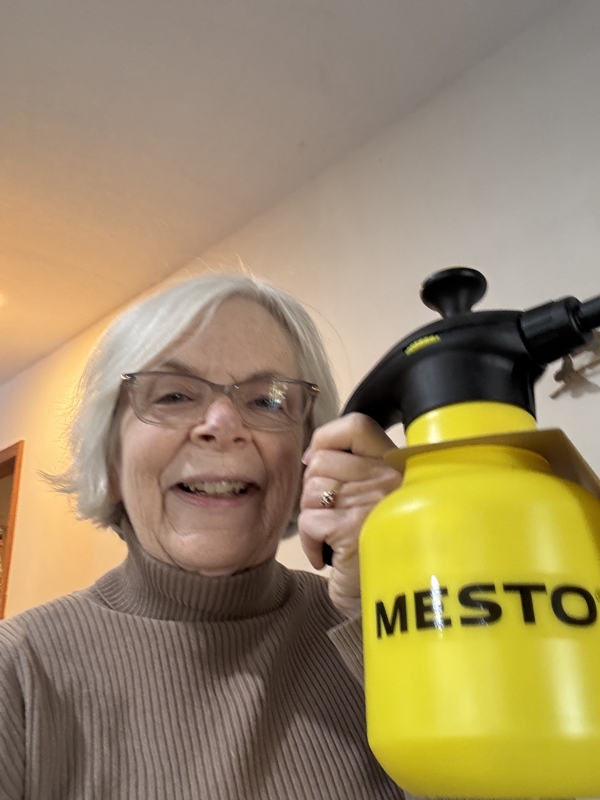
Linda is a big fan of Garden Answers. The host, Laura, uses a Mesto sprayer to mist her plants when they first sprout, so I bought Linda one.

The Storm
As everyone, who has lived in the Midwest for any amount of time knows, winter storms come and go, and except for the inconvenience of snow and its removal, they aren’t that big a deal. The storm that rolled through on the second week of February was the exception.
The low temps were forecasted to be around -10 with windchill approaching -25. This was a problem.
I know that under ordinary conditions, the greenhouse maintains around 30 degrees above ambient. What was coming was not ordinary, so we had to do something, even if it was wrong.

We decided to seal off the known drafty areas with plastic sheeting and then create a “tent” around the exposed plants.


This sort of worked, next time we’ll try a different approach.

Just before the storm came in we saw this very large group of wild turkeys in the backyard.
The temperature and wind wasn’t as bad as expected, but it did some damage.


This was a big setback, but it could have been much worse.
Storm Recovery
Since the storm, we have replanted much of what was lost.

The Fan
As events are around here after the storm came some very hot – seasonally hot – days that required me to install the exhaust fan that I had hoped to put off for a few more weeks.

Fortunately, the hole I had framed in for it was exactly correct, so it slid into place easily. It is a 14-inch fan that I wired to an analog thermostat.
It doesn’t make too much noise and so far it is working well.
Conclusion
I think that gets us caught up. I’ve added a new shelf to the greenhouse and a drop-down work shelf to make work flow a little easier.


A few pictures of the plants.


Last modified:
Leave a Reply