1/5/2025
Introduction
I started this post on November 24th. At the time, I figured it would take a couple of hours to sort out the pictures and video and then another hour or so to tell the story. I was wrong to say the least. With December approaching it was time to finish preparing the greenhouse. This took nearly every available minute. More on that later.
The Bees
On October 21, 2024, we planned to inspect the hives and collect any excess honey. Much of the morning was spent finding all the equipment purchased last year and coming up with a plan to get the honey out of the frames.
After the prep work, we went out to inspect the hives. The bees were less than pleased with our intrusion. In fact, they were decidedly hostile.
The video tells the story.
All we accomplished, other than making the bees angry, was the removal of several empty frames. I think I was stung through my gloves three times. Impressive. The bees were busy moving the honey from the frames it was first placed to the brood area for winter feeding. This explains why they were aggressive.
All of the hives had 3 or more full frames of honey, so they should be okay this winter.
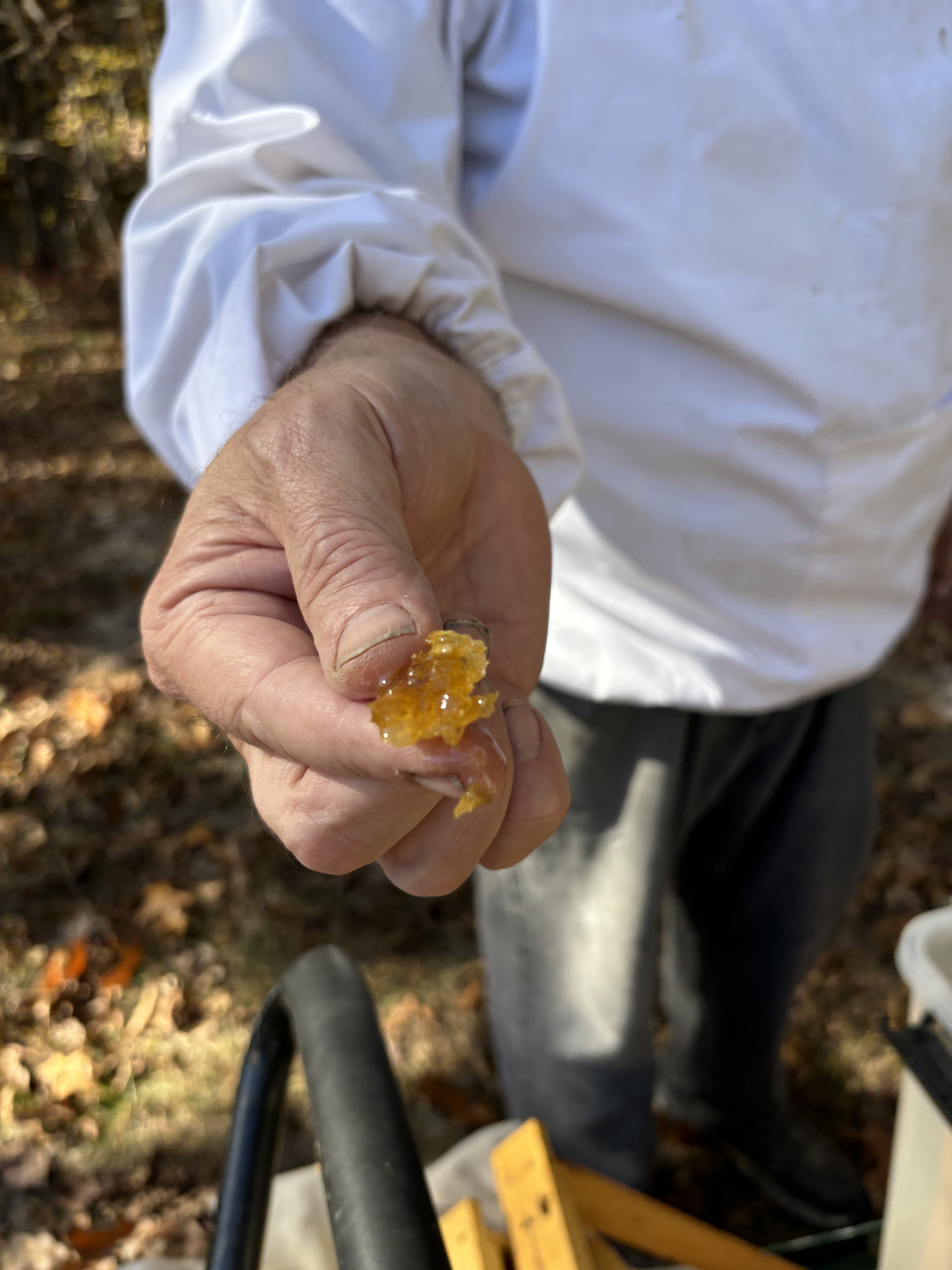
Just a bite of honey to taste.

It was good!
On November 21st, we put the bees to bed for the season. This means that we removed all frames that were not in use, shut the opening down to the winter setting, and placed a wool pillow over the remaining frames. The pillow is there to soak up any excess humidity.


They should from all appearances, due well this winter.
The lavender bed
This is a topic that still irks me a little. Last spring we sent a sample of soil to be tested. Among other things the soil is very acidic with a pH of around 3.0. The recommendation was to add lime, which makes sense. We called and asked the chemist about planting now, before adding lime since we had 40 or more plants to put in the ground. He said it would be fine, just add some lime in the fall.
We called back this fall and asked about how much lime to use. He said we should have not planted anything and that lime would need to be added to the soil for four years before planting lavender. He did not recall his previous statements.
Linda is a huge fan of Garden Answer. On that channel, Lara almost exclusively uses products by Espoma. The products are organic and advertised as “Long-Lasting Slow-Release Feeding.” So we decided to purchase a good-sized quantity of Garden Lime, Gypsum, and Bone Meal from Shirks County Market.


The lime is to increase the pH level, the gypsum to break down clay, and the bone meal is a fertilizer for the lavender.
We also bought several bags of composted cotton burr to use as an additive for the soil.
On October 19th, we began to rehab the lavender bed mounds. It was hard work. First, we pulled back the landscape cloth, then sprinkled on the lime, gypsum, and bone meal, and finally added a large quantity of the cotton burr. I think it took three days to get this done.
A few pictures of the endeavor with Yogi the cat supervising.


The greenhouse
The greenhouse makeover has been amazing! It went from a broken-down shell into a structure that is both usable and attractive. We have shown several pictures of the progress this year and I hope they were enjoyable.
On October 22nd, I built the supports for the major beds of the greenhouse. The most difficult part was deciding on what would work.


I think the support looks pretty good. Way over-engineered, which is my style, but I know the beds won’t collapse any time soon.
It was time to build the beds. This time instead of a bed with a solid bottom like I had before, I decided to have a simple front and back with strips attached to the bottom.


Now it was time to outfit the greenhouse with a little equipment. We bought a set of 6 3-foot grow lights, a 14-inch exhaust fan – yet to be installed, a heater, a lot of heat mats, and a shelf unit to give us more room for plants.


In addition to the above, I built an instrument package that monitors greenhouse temperature and humidity, the bed temperature, and the temperature and humidity of the barn. The best thing is the dashboard I created to display all the data plus other important measurements

While we were at it, we replaced all the existing shelves in the barn with new functional ones.


It’s nice to see stuff off the floor and almost organized.
Today we put the greenhouse to work by planting some lettuce and geraniums.

Callaway Plant 40th Reunion
This might seem off-topic, but the Callaway Plant is an important part of our lives. I worked there from November of 1975 to June of 1996. On October 5th, the plant held a reunion to celebrate 40 years of operation. It was my first time at the plant after leaving the company.


Conclusion
I know this was a very long post, but there were many things to catch up on. I hope you enjoy it.
Last modified:

Leave a Reply