11/3/2023
The bee season has gone by quickly and, of course, I’m behind in everything. The season has been educational. We’ll have a better idea next season about what really matters versus what books say.
I’m not criticizing anything or anyone. It’s a matter of putting theory into practice. Theory get you started but the practice is what actually produces results.
All that said, the final inspection was meant to be a quick in and out. Hopefully in under 10 minutes – just what we needed to do to minimize the disturbance of the hive.
We opened the hive and:
- removed items not being used
- counted the number of frames being used
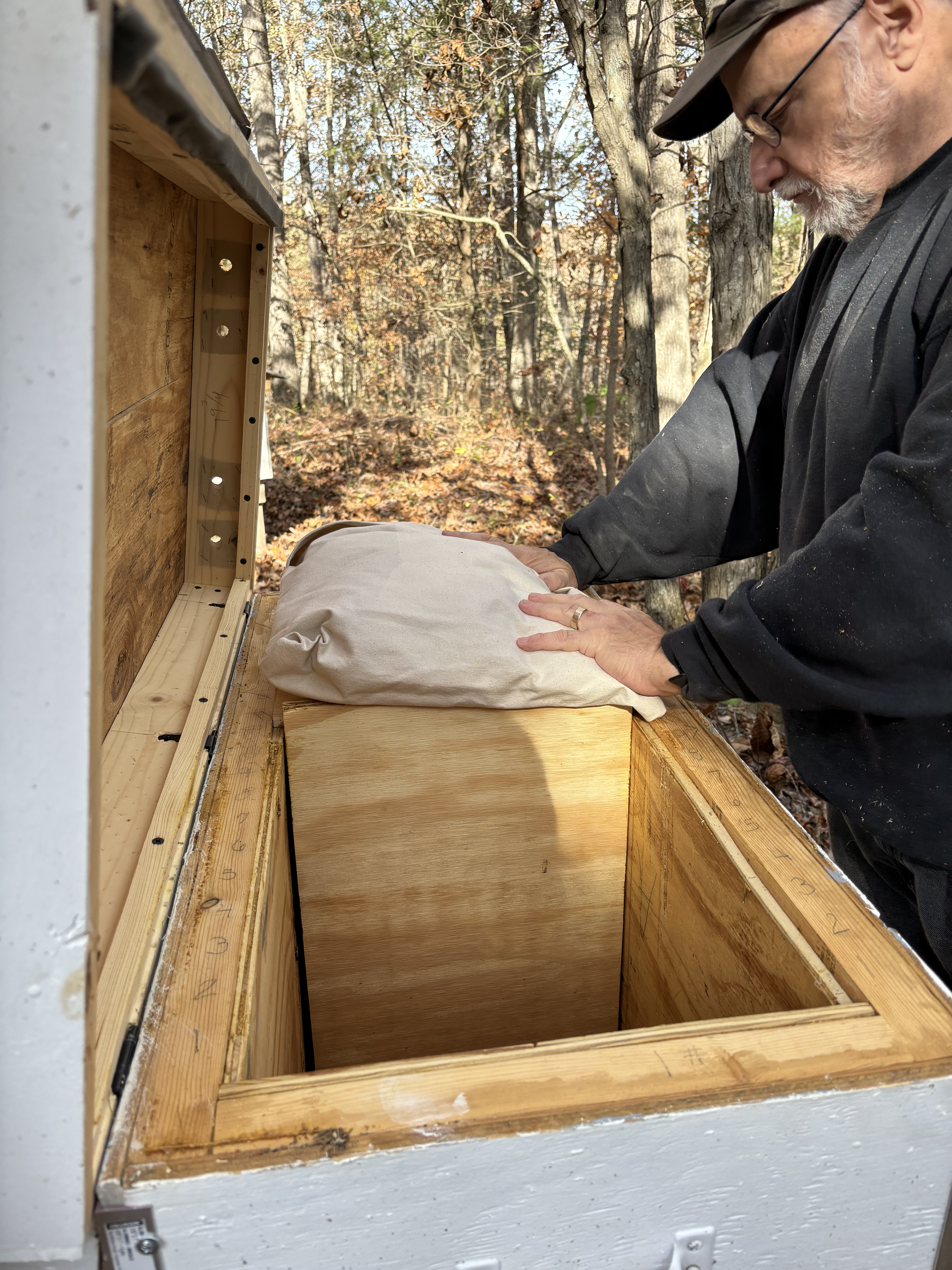
- put a wool pillow over the remaining frames
- closed up the hive
- reduced the opening size to prevent intruders like mice from getting in
Sounds simple, theoretically, and in this time in actual practice.

In addition to the feeder, there were two frames that weren’t being used. It was important to remove these items because during very cold weather they can act like ice cycles and have a significant effect on the temperature of the hive.
It was important to see how many frames were in actual use to make a decision to actually remove any honey hives. Excess honey hives can also act like ice cycles. For a first year colony, there should be between six and eight frames being used at the end of the season. There were eight being used, so at this point, we stopped the inspection and closed up the hive.
Why a pillow?
This question is a little complicated. We hope the explanation below helps you to understand the need for one.

The pillow was purchased from horizontalhive.com. They are made by Dr. Leo’s daughter.
Why wool?
Most of us, or maybe just me, remember having your own wool blanket that your curled up in on a cold winter night. The wool trapped our body heat and while it didn’t add any heat, it sure felt like it did.
The pillow does a similar function as well as to help absorb humidity.
What humidity?
In the winter, honeybees cluster tightly inside of the hive to stay warm. The worker bees vibrate their bodies to generate heat. The queen is toward the center of the cluster where the temperature is around 90–100 °F.
Clusters have two parts: a dense out mantel and a loose inner core. In the outer mantel, bees are packed together to retain heat. Toward the center, the bees are loosely packed and can freely move around. The cluster expands or contracts depending on the outside temperature.
The effect of the bees maintaining the temperature of hive as well as just normal breathing is that air moves in and out of the hive. As the bees breath, some amount of water is released in the hive.
This water can condense and if it the condensate falls on the cluster, the temperature of the cluster reduces. The end result can be death to the hive.
To deal with this problem ventilation during the winter doesn’t change. The opening, though reduced in size, remains open so that air can enter the hive. The air in the hive will heat up, becoming less dense, and rises to the top of the hive to where the pillow is. Any excess moisture will condense in the pillow and hopefully keep the bees dry.
So the last inspection is pretty important.
The plan is to keep the hive closed up until next spring. And then we will see if the colony survived or not.
Last modified:
Like I said, I’m a little behind.
Leave a Reply